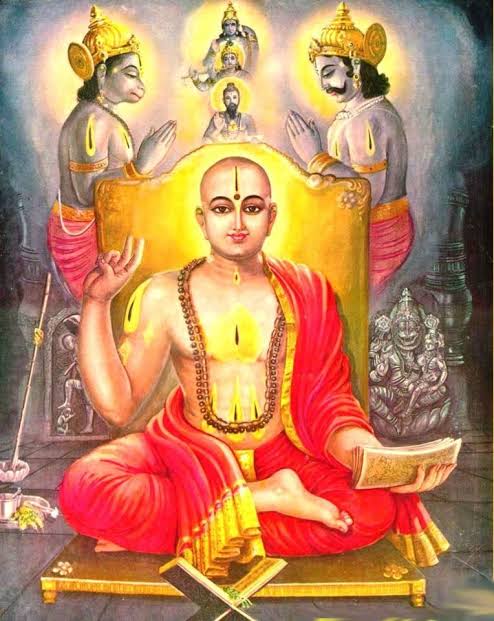
Biography
Unlike Adi Shankara’s Advaita (which states the soul and God are one), Madhvacharya taught Tattvavada—the philosophy of realism and absolute dualism. His teachings center on the supreme, independent sovereignty of Lord Vishnu (Brahman).
Early Life
Birth & Auspicious Signs: He was born in 1238 CE on Vijayadashami day in Pajaka Kshetra, a small village near Udupi, Karnataka. His parents, Madhyageha Bhatta and Vedavati, named him Vasudeva. They were a devout couple who had lost previous children and prayed intensely for a son at the local Ananteshwara temple. Prodigious Childhood: From a very young age, Vasudeva displayed extraordinary intellectual and physical strength. Traditional accounts highlight early miracles—such as effortlessly digesting a vast quantity of raw horsegram given to him by a creditor to clear his father's debt, and single-handedly wrestling and destroying a fierce demon who took the form of a serpent at Pajaka. Brilliant Intellect: He began formal schooling at age five. He quickly mastered languages, grammar, and traditional scriptures. Often, he would politely correct his own teachers during lessons, demonstrating an innate understanding of the Vedas that far outpaced anyone around him. Monastic Initiation: Even as a young boy, Vasudeva felt a strong pull toward total spiritual renunciation. At the age of eleven, despite his parents' initial heartbreak and resistance, he left home to pursue monastic life. He was initiated into Sannyasa (monthood) by the respected ascetic Achyutapreksha in Udupi, who gave him the monastic name Purna Prajna.
Key Achievements
- Founded the Udupi Krishna Matha (Sri Krishna Temple) around 1285 CE
- Established the Ashta Mathas (eight monasteries) in Udupi — a tradition of governance still active today
- Composed 37 Sanskrit works collectively known as the Sarvamula Granthas
- Founded Tattvavada (Dvaita Vedanta) — the philosophy of absolute dualism between God and the individual soul
- Introduced the Paryaya system of temple administration, rotating every two years among the eight mathas
- Installed the idol of Lord Krishna at Udupi, said to have been discovered from a clay mound inside a ship
- Defeated prominent scholars of Advaita and other schools in philosophical debates across India
- Established the tradition of Bhajana and Kirtana in Udupi, influencing the Haridasa movement
Notable Works
- Brahmasutra Bhashya — commentary on the Brahma Sutras establishing Dvaita philosophy
- Bhagavata Tatparya Nirnaya — interpretation of the Bhagavata Purana
- Mahabharata Tatparya Nirnaya — analysis of the Mahabharata
- Gita Bhashya — commentary on the Bhagavad Gita
- Vishnu Tattva Vinirnaya — treatise on the nature of Vishnu
- Anuvyakhyana — elaboration on the Brahmasutra Bhashya
- Rigbhashya — commentary on the Rig Veda
- Pramana Lakshana — treatise on epistemology
- Katha Lakshana — work on logic and debate
- Upadhikhandana — refutation of the concept of Upadhi
Honors & Awards
- Poorna Prajna — title meaning "one of complete knowledge"
- Ananda Tirtha — title meaning "one who is a ford of bliss"
- Revered as the third avatara of Mukhyaprana (Vayu) after Hanuman and Bhima
- Recognised as one of the three great Acharyas of Vedanta alongside Adi Shankara and Ramanujacharya
- Udupi declared a major pilgrimage centre due to his establishment of the Krishna Matha
- His Paryaya system has been uninterruptedly followed for over 700 years
Works of Sri Madhvacharya
He wrote 37 distinct Sanskrit works, known collectively as the Sarvamula Granthas. His style was famously condensed, precise, and brief. Major works include: Anuvyakhyana (A brilliant philosophical commentary on the Brahma Sutras) Gita Bhashya and Gita Tatparya Detailed commentaries on the 10 principal Upanishads Mahabharata Tatparya Nirnaya