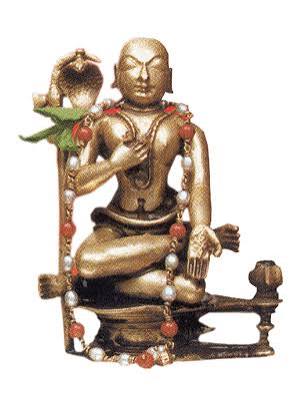
Sri Vadiraja Tirtha
Sri Vadiraja Swamy is arguably the most influential, multi-faceted noble person in Udupi's history after Madhvacharya himself. He was the pontiff of the Sode Matha (one of the Ashta Mathas) and lived for an incredible 120 years.
Biography
Born as Bhoo Varaha in the village of Hoovinakere (near Kundapura, Udupi) to a pious Shivalli Madhva Brahmin couple, Ramacharya and Gouri Devi, his entry into the world was miraculous. Bound by a vow made to the local pontiff, Sri Vagisha Tirtha, his parents dedicated him to the monastic order because he was born just outside the threshold of their house in a paddy field. He was brought up under the careful spiritual guidance of the matha and was ordained into Sannyasa at the tender age of eight, receiving the monastic name Vadiraja Tirtha.
Early Life
The childhood of Sri Vadiraja Tirtha is a blend of simple rural life in coastal Karnataka and extraordinary spiritual destiny. 1. The Pious Couple & The Vow In the late 15th century, a devout Shivalli Madhva Brahmin couple, Ramacharya and Gouri Devi, lived in the quiet village of Hoovinakere (near Kundapura, Udupi district). Though deeply spiritual, they were heartbroken over being childless. They approached Sri Vagisha Tirtha, the ruling pontiff of the Sode Matha, seeking his blessings for a child. The Swami granted the blessing but laid down a profound, testing condition: "If the child is born inside the walls of your house, he belongs to you. But if he is born outside the house, you must dedicate him to the service of God and the Matha." The couple agreed to the condition with faith, viewing it as divine will. 2. The Miraculous Birth in the Paddy Field (1480 CE) As Gouri Devi's pregnancy neared its full term, she went about her daily routine in the village. One morning, she walked out into the nearby family paddy fields to gather some wild greens for cooking. Suddenly and unexpectedly, she went into intense labor right there in the open field, far outside the threshold of her home. On Sadhana Dwadashi, she gave birth to a radiant baby boy. True to their solemn vow, the parents knew this child was destined for a higher spiritual purpose. They named the infant Bhoo Varaha (or Varahacharya). 3. A Prodigious Childhood From his earliest days, young Bhoo Varaha displayed a serene demeanor and a brilliant intellect that stunned the villagers of Hoovinakere: He showed an effortless mastery over local languages, grammar, and elementary scriptures. Unlike other children, his play often revolved around worshipping local deities and reciting verses. Realizing the boy's immense potential and keeping his word, Ramacharya took the young boy to Sri Vagisha Tirtha when he reached the age of formal learning. The Swami was deeply impressed by the child's sharp wit, pure character, and glowing spiritual aura. 4. Monastic Initiation at Age Eight When Bhoo Varaha was just eight years old, he was formally initiated into the monastic order (Sannyasa). Leaving behind his family and worldly attachments, he took his vows under Sri Vagisha Tirtha, who bestowed upon him the name Sri Vadiraja Tirtha. Despite his tender age, he began rigorous training in the Sarvamula Granthas (the core works of Sri Madhvacharya), Vedic logic, and advanced Sanskrit texts, quickly rising to become one of the most formidable young scholars in the entire Udupi region.
Key Achievements
- Sri Vadiraja Tirtha’s 120-year lifespan was marked by extraordinary contributions that fundamentally reshaped the religious, social, and architectural landscape of Udupi and coastal Karnataka.
- 1. Revolutionized the Udupi Paryaya System (1532 CE)
- When Sri Madhvacharya originally established the Ashta Mathas (Eight Monasteries) of Udupi, he ordained a 2-month rotation for each matha to take turns managing the Sri Krishna Temple.
- As the temple grew, a 2-month period proved far too short for any systematic administration, spiritual discipline, or major festival planning.
- In 1532 CE, during a grand regional assembly, Sri Vadiraja overhauling this structure by extending the tenure to 2 years. This modern Paryaya system brought stability and allowed each matha to undertake substantial development, a democratic tradition beautifully maintained to this day.
- 2. Structural Reconstruction of Udupi Krishna Mutt
- The physical layout of the Udupi Sri Krishna Temple complex as we see it today is largely the architectural genius of Sri Vadiraja.
- He renovated the inner sanctum, built the surrounding corridors, and systematically organized the temple kitchens and dining halls to handle mass feeding (Anna Brahma).
- He also formally reconstructed and sanctified the Madhwa Sarovara (the sacred temple tank) with stone steps, making it a central point for daily temple rituals.
- 3. Champions of Social Inclusivity & Kanakanakindi
- Sri Vadiraja was a progressive saint who looked past rigid caste hierarchies to honor true spiritual devotion.
- When the legendary saint-composer Kanakadasa arrived in Udupi, he was denied entry into the temple due to his lower-caste birth. He sat outside the western wall, singing his heart out to Lord Krishna.
- Recognizing Kanakadasa's pure bhakti, Sri Vadiraja arranged for his stay. When a crack opened in the wall and the idol miraculously turned to face west to give Kanakadasa a glimpse, Sri Vadiraja didn't cover it up; instead, he expanded it into a beautifully carved window frame. This window, Kanakanakindi, remains the focal point through which every devotee views Lord Krishna today.
- 4. Pioneering the Haridasa Movement in Coastal Karnataka
- While a master of heavy, logical Sanskrit philosophy (authoring texts like Yukti Mallika), Sri Vadiraja realized that high-level philosophy could not easily reach common households.
- He became a prolific composer of Devaranamas (devotional songs) in the local vernaculars of Kannada and Tulu, using the pen name (Ankita Nama) Hayavadana.
- He composed the famous Vaikuntha Varnane in Kannada, allowing everyone, regardless of educational background, to sing, understand, and participate in spiritual life.
- 5. Agricultural Blessing: The Mattu Gulla Brinjal
- Sri Vadiraja deeply cared for the local economy and ordinary working communities. The farmers of Mattu village (near Katapadi, Udupi) were facing severe crop failures.
- Sri Vadiraja gave them consecrated seeds and blessed their land. The result was a unique, delicious, round green brinjal known as Mattu Gulla.
- To show their gratitude, the farmers vowed that their very first harvest would always be offered to Udupi Lord Krishna for the temple community kitchens—a sacred tradition that continues faithfully every season.
- 6. Architectural Legacy at Sode (Sajeeva Vrindavana)
- Aside from his work in Udupi, he established the primary base of the Sode Matha at Sode (near Sirsi). He designed a unique layout consisting of five distinct Vrindavanas. In 1600 CE, he voluntarily entered his tomb alive (Sajeeva Vrindavana) in front of thousands of witnesses, leaving behind a powerful spiritual energy center that attracts devotees to this day.
Notable Works
- Sri Vadiraja Tirtha was an incredibly versatile and prolific writer. He composed over 60 major works ranging from heavy, logical Sanskrit treatises to simple, deeply emotional devotional songs in regional languages.
- He wrote under the sacred pen name (Ankita Nama) Hayavadana, dedicating his creativity to the horse-necked avatar of Lord Vishnu.
- 1. Masterpieces in Sanskrit (Philosophy & Logic)
- Yukti Mallika (The Garland of Logical Arguments): This is universally considered his magnum opus. It is a massive, independent treatise written in poetic verses that defends Sri Madhvacharya's Dvaita (Dualism) while systematically critiquing Advaita (Non-dualism) using razor-sharp logic, everyday analogies, and dry wit.
- Nyaya Ratnavali: A brilliant commentary that unpacks the complex philosophical layers of the Brahma Sutras from a dualistic perspective.
- Pasanda Khandanam & Upadhi Khandanam: Specialized polemical tracts specifically written to break down and refute opposing logical systems of thought.
- 2. Devotional Literature & Travelogues (Sanskrit)
- Teertha Prabandha (The Travel Guide to Pilgrimages): Sri Vadiraja traveled extensively across India twice. During his journeys, he composed this beautiful, unique geographical and devotional travelogue. It describes the holy rivers, temples, and landscapes of India from the deep South all the way up to Badrikashrama in the Himalayas, capturing the local spiritual essence of each stop.
- Rukminisha Vijaya: A classic mahakavya (epic poem) consisting of 19 chapters that beautifully narrates the life of Lord Krishna, focusing heavily on his marriage to Rukmini. It is celebrated for its rich imagery and grammatical elegance.
- 3. Vernacular Masterpieces (Kannada & Tulu)
- Sri Vadiraja was a pioneer who believed that high philosophy shouldn't be locked away in Sanskrit. He translated deep spiritual truths into local languages so everyone could learn them.
- Vaikuntha Varnane: Written in simple, beautiful Kannada using the traditional Sangatya meter, this poetic work describes the divine abode of Lord Vishnu (Vaikuntha) and explains how souls experience liberation (Moksha) without losing their individual identity.
- Bhramagita: A beautiful vernacular exposition that simplifies complex Vedic thoughts into devotional poetry.
- Lakshmi Shobhane: One of his most popular and auspicious household compositions in Kannada. It describes the wedding of Goddess Lakshmi and Lord Vishnu. To this day, it is sung dynamically across households in Karnataka during weddings and Fridays for peace and prosperity.
- Hundreds of Devaranamas (Kirtanas): He wrote countless devotional hymns in Kannada and Tulu that are integral to the Haridasa musical tradition, heavily influencing later saints like Purandara Dasa.
Works of Sri Vadiraja Tirtha
Sri Vadiraja Tirtha composed over 60 distinct works. He was a unique literary genius who could write dense, razor-sharp logical arguments in Sanskrit, and switch to composing soulful, simple devotional songs in Kannada and Tulu under his pen name (Ankita Nama) Hayavadana. 1. Core Philosophical Works (Sanskrit) These treatises were written to defend Sri Madhvacharya's Dvaita (Dualism) philosophy and logically critique Advaita (Non-dualism). Yukti Mallika (The Garland of Arguments): His masterpiece. A massive work that uses everyday analogies and rigorous logic to prove the eternal reality of the world and the distinction between the soul and God. Nyaya Ratnavali: A detailed, verse-by-verse logical analysis of the Brahma Sutras. Pasanda Khandanam & Upadhi Khandanam: Sharp, analytical texts written to counter and dismantle opposing schools of thought. Gita Tatparya Teeka Tippani: A precise sub-commentary that clarifies the deep layers of Madhvacharya's commentary on the Bhagavad Gita. 2. Epic Poetry, Literature & Travelogues (Sanskrit) These works highlight his mastery over classical Sanskrit grammar, aesthetics, and poetry. Teertha Prabandha (The Pilgrimage Travelogue): A fascinating, first-of-its-kind spiritual travelogue written during his two walking tours of India. It details the geography, holy rivers, and deities from Rameswaram in the south to Badrinath in the north. Rukminisha Vijaya: A highly celebrated classical epic poem (Mahakavya) describing the life of Lord Krishna and his marriage to Rukmini. It is considered a masterpiece of Sanskrit literature for its structural elegance. Srimad Bhagavata Laksha Alankara: A monumental commentary analyzing one lakh (100,000) specific attributes and deep meanings found within the Bhagavata Purana. 3. Popular Vernacular Compositions (Kannada & Tulu) Sri Vadiraja was a key pioneer of the Haridasa Bhakti Movement. He wrote these works so that high-level Vedic philosophy could be understood by common households. Lakshmi Shobhane: A highly popular, auspicious song describing the wedding of Goddess Lakshmi and Lord Vishnu. It is traditionally sung in homes across Karnataka on Fridays and during weddings for blessings. Vaikuntha Varnane: Written in the rhythmic Kannada Sangatya meter, this work beautifully describes the spiritual realm of Vaikuntha and the nature of soul liberation (Moksha). Haribhakti Sara: A deeply emotional collection of verses focusing on complete surrender (Sharanagati) to God. Hundreds of Devaranamas: Countless devotional kirtanas (songs) composed in local languages that are still performed daily in South Indian classical and devotional music.